
The Beat Beneath the Hate
Add the Rhythm of We the People and We dance together

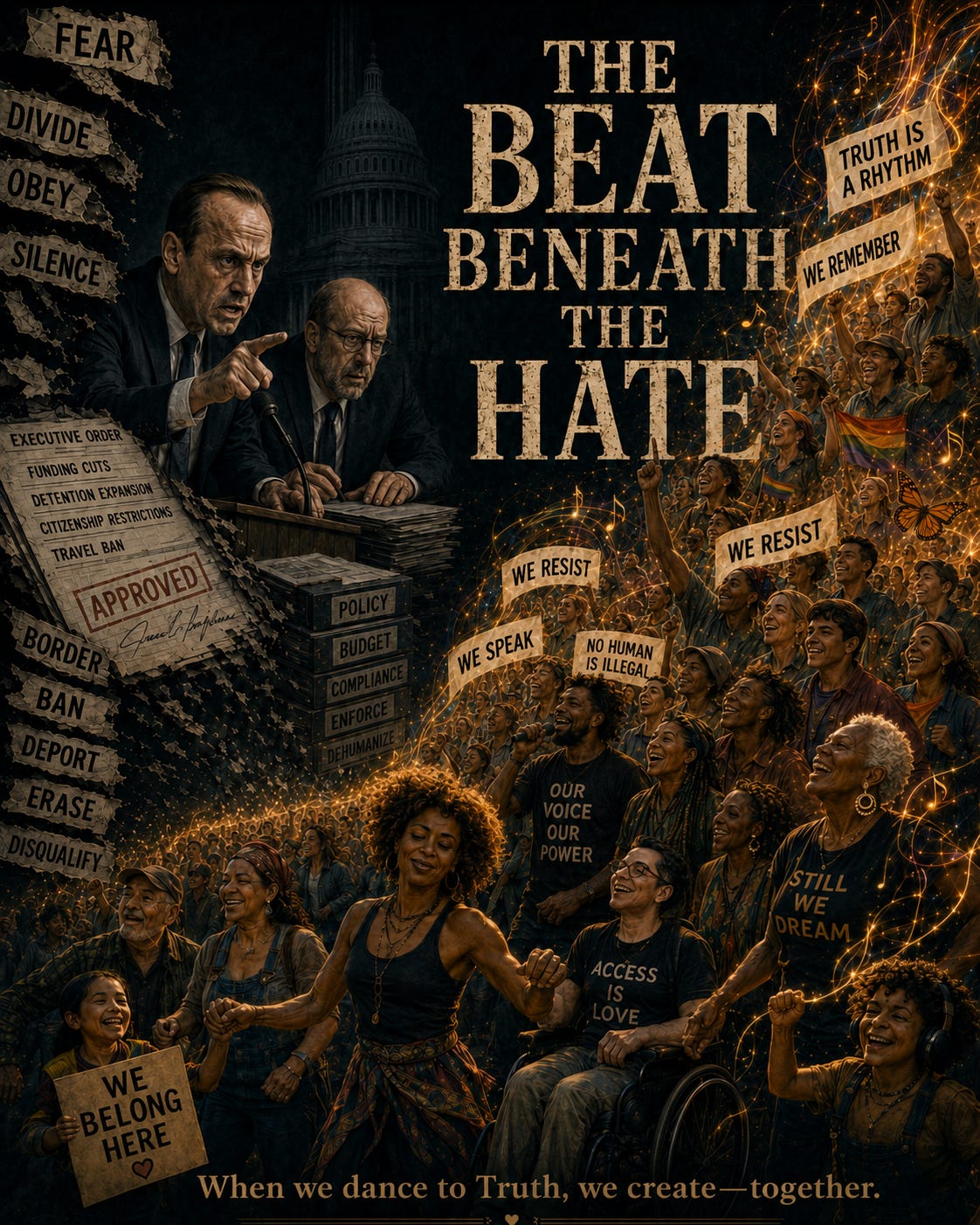
“When we dance to Truth, we create—together.”
THE BEAT BENEATH THE HATE
There is always a beat beneath it.
Beneath the speech.
Beneath the podium.
Beneath the narrow little mouth
curling itself around the word enemy.
There is always a beat.
And Stephen Miller knows it.
Oh, Wee Wierdo Stevie knows the rhythm well.
Not music.
Never music.
Music requires breath.
Music requires listening.
Music requires another human being
to exist outside your own skull.
No.
His beat is smaller than that.
A boot on a stair.
A fist on a desk.
A name repeated until it becomes a target.
Alien.
Invader.
Criminal.
Enemy within.
Again.
Alien.
Invader.
Criminal.
Enemy within.
He understands what demagogues always understand:
People remember the chorus
long after they have forgotten the argument.
So he gives them a chorus.
Brown people are coming.
Poor people are taking.
Left people are plotting.
Different people are dangerous.
He takes the ancient drum of fear
and tightens the skin.
Harder.
Harder.
Until frightened people begin marching
to a rhythm written against their neighbors.
And there he stands—
the boy who grew into the sneer,
the sneer that found a suit,
the suit that found a microphone,
the microphone that found a nation
already taught to confuse cruelty with strength.
He does not need the sentence to be true.
He only needs it to scan.
He only needs it to rhyme
with the fear already planted.
And while Stevie writes the chorus,
Russell Vought writes the contract.
There he is.
Quiet.
Careful.
No froth at the mouth.
No wild eyes necessary.
He does not need to shout enemy.
He simply opens a document.
Section One:
Remove the people who might say no.
Section Two:
Starve the office that keeps the old woman alive.
Section Three:
Call the failure efficiency.
Section Four:
Call the suffering reform.
Section Five:
Call obedience freedom.
Miller writes the lyric.
Vought builds the stage.
Miller points at the crowd
and tells them whom to hate.
Vought dims the lights,
locks the exits,
cuts the power
and insists the darkness is constitutional.
That is how the trick works.
Hatred does not arrive alone.
It brings paperwork.
It brings policy.
It brings a man with a clean collar
and a sharpened pencil
who has learned how to remove a human life
without ever touching the body.
No blood on the hands.
Only ink.
Only clauses.
Only a signature placed gently
beneath the sentence that says:
Your medicine is too expensive.
Your disability is inconvenient.
Your hunger is not our concern.
Your age has exceeded its usefulness.
Your child was born on the wrong side
of somebody else’s border.
And this is where they make their mistake.
They think people do not understand.
They think if the sentence is long enough,
the cruelty disappears.
They think if they bury the verb
under pages of policy,
we will not notice who is doing what to whom.
They think hunger becomes less hungry
when renamed a budget adjustment.
They think abandonment becomes governance
when placed in twelve-point type.
They think the beat belongs to them.
But it does not.
The beat was here before them.
It was in the field.
It was in the factory.
It was in the church basement
where frightened people learned each other’s names.
It was in the march.
It was in the union hall.
It was in the hand
reaching backward through the crowd
to pull one more person forward.
We know rhythm too.
We know the sound of a lie
when it stumbles over its own feet.
We know the silence after a benefit is cut.
We know the knock at the door.
We know the mother holding the letter
she cannot decipher
but understands perfectly.
Denied.
Denied.
Denied.
There is your chorus, Russell.
There is your song, Stevie.
But listen carefully.
Because beneath your beat
another one is rising.
Not the boot.
The pulse.
Not the slogan.
The breath.
Not the lonely little rhythm
of one frightened man
who must keep inventing enemies
in order to feel tall.
No.
This is the sound
of people finding one another.
This is fact becoming language.
Language becoming rhythm.
Rhythm becoming courage.
Courage becoming bodies
standing where they were told to disappear.
You can write us into categories.
You can call us burdens.
You can rank our worth
by color, wealth, obedience, birthplace, usefulness.
You can build your little threshold
and stand above it
deciding who deserves to live comfortably
and who may be discarded.
But Truth has a beat.
And Truth does not stay buried.
It gets up.
It finds the floor.
It takes the hand of every person
you reduced to a number.
And then it dances.
Old and young.
Brown and Black.
Disabled and poor.
Queer and foreign.
Workers and dreamers.
The unwanted.
The unprofitable.
The people your documents forgot
were people.
And when we dance to Truth,
your contracts tear.
Your chorus breaks.
Your little rhythm of fear
loses the room.
Because hatred may write the first lyric.
Power may purchase the stage.
But people—
people decide
which song survives.
ONEness Warrior